Swyqalen
Neon Sphere
Neon Sphere
Couldn't load pickup availability
-
Problem Statement
At this stage of Swift study, learners often know several separate ideas but may still find it difficult to bring them into one organized code flow. A value can be named correctly, a function can be written, and a condition can be understood, yet the full structure may still feel unclear when several parts appear together. Learners may also struggle with deciding where logic should be placed, how data should move through a function, and how a small example can be expanded without becoming messy. Some learning materials introduce larger samples with too few notes, leaving learners to guess why the structure was written in that way. Neon Sphere was created for learners who want a more detailed study tier that connects Swift fundamentals with broader practice. -
Solution
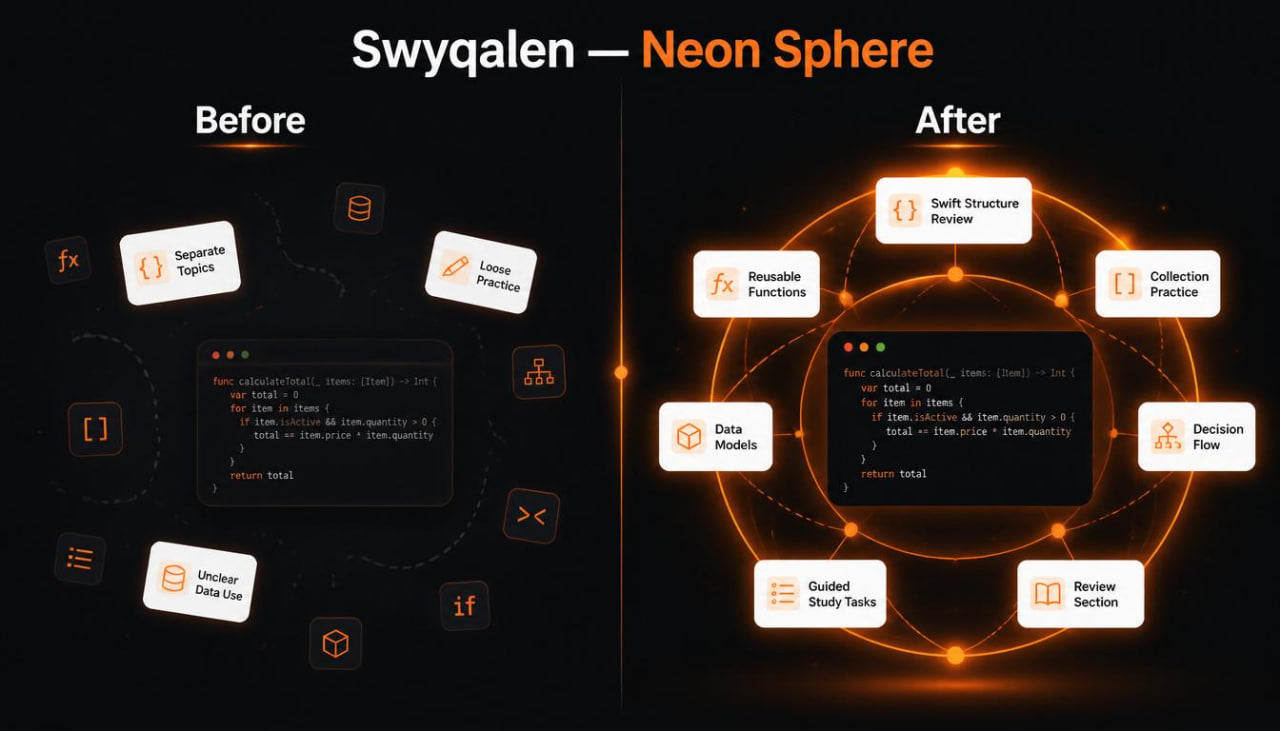
Neon Sphere gives learners a wider Swyqalen course tier focused on structure, reusable code, grouped data, and careful practice. The materials are arranged so each topic begins with explanation, then moves into annotated examples, then continues into practice tasks and recap pages. Learners are shown how to read code as a sequence of choices rather than a block of text. The course also gives more attention to how small parts relate to one another, including functions, conditions, collections, and data models. This creates a steady learning flow for learners who want more than beginner examples but still prefer a guided written format. -
What’s Inside
Neon Sphere includes a detailed set of Swift learning materials arranged around connected code structure and practical study. The course begins with a study orientation file that explains how the tier is organized, how to work with the written modules, how to review examples, and how to complete the practice tasks. This opening section also gives learners a suggested reading rhythm: study the explanation, review the annotated sample, complete a small task, then return to the recap notes.
The first module focuses on Swift structure review. It revisits values, variables, constants, data types, conditions, loops, functions, and collections, but not as isolated beginner topics. Instead, each idea is shown inside a small connected example. Learners review how a value is created, how a function uses it, how a condition changes the result, and how a collection can hold related information.
The second module focuses on reusable thinking. Learners study how functions can be arranged to avoid repeated code, how parameters pass information into a function, and how return values carry information out. The examples show small function chains where one function prepares information and another function checks or formats it. Practice tasks ask learners to identify repeated logic, write a function outline, and review how each part of the function supports the final result.
The third module introduces deeper collection practice. Learners work with grouped values, repeated actions, simple filtering ideas, and small collection updates. The examples remain readable, but they include more steps than earlier tiers. Learners study how a collection is created, how each item is reviewed, how a condition can be applied to items, and how a result can be formed from that process.
The fourth module focuses on small data models. Learners review how related information can be grouped into a named structure and used inside examples. The course explains how fields describe the data, how sample values can be created, and how those values can be passed into functions. This module is useful for learners who want to understand how code can represent organized information rather than only single values.
The fifth module studies decision flow. It covers condition blocks, fallback paths, multiple checks, and readable logic order. Learners review examples where different input values create different outcomes. The course explains how to read each branch, how to avoid unclear nesting, and how to describe logic in plain language before writing it.
The sixth module introduces small project-style exercises without using heavy technical pressure. These are not large builds. They are guided study tasks that combine values, data models, collections, conditions, and functions. Each task begins with a short scenario, then a planning note, then a partially completed example. Learners complete missing parts, label sections, and compare their work with answer notes.
The seventh module is a review section. It gathers the main patterns from the course into recap pages, glossary notes, mixed examples, and self-check tasks. Learners can return to this section after finishing the course to review structure, naming, condition flow, collection work, and reusable code patterns.
Neon Sphere also includes organized practice pages, selected answer notes, recap sheets, glossary entries, and study prompts. The material is written for steady review and thoughtful repetition, giving learners room to revisit each topic when needed.
-
Who Is This For?
Neon Sphere is for learners who already understand early Swift basics and want a wider course tier with more connected practice. It is suitable for learners who have studied variables, conditions, loops, functions, and collections, but want more time with examples that combine those ideas.
This tier is also a good fit for learners who prefer written study materials with a calm structure. It works well for people who like to read explanations, examine annotated code, complete practice tasks, and return to recap pages for review.
Neon Sphere is intended for learners who want to move from small examples into more organized code thinking. It is not written as a broad technical manual, and it does not claim to cover every Swift topic. Instead, it focuses on helping learners study practical structure, reusable patterns, grouped data, and mixed exercises in a measured way.
- What You’ll Learn
- How to connect values, functions, conditions, and collections in Swift examples
- How to read code as a sequence of decisions and actions
- How reusable functions can reduce repeated patterns
- How parameters carry information into a function
- How return values carry information out of a function
- How grouped values can be reviewed through collection practice
- How simple filtering ideas can be written in a readable way
- How small data models can describe related information
- How sample values can be created and used in tasks
- How condition branches guide different outcomes
- How fallback paths can be arranged with care
- How to plan a short coding task before completing it
- How to complete mixed practice exercises with several Swift topics
- How to use recap pages for later review
- How to describe code behavior in plain language before editing it
-
30-Day Refund Window
Neon Sphere includes a 30-day refund window for learners who find that the course materials do not match the written description or the order details. Learners can contact Swyqalen support within 30 days of purchase and include their order information with a short explanation of the issue.
Self-paced learning overview
- 📁 Digital file available after purchase
- 🧭 Long-term availability
- 🔐 Secure checkout
- 🗓️ Content updated in 2026
What format are Swyqalen courses provided in?
What format are Swyqalen courses provided in?
Swyqalen courses are provided as digital learning materials with written modules, examples, practice tasks, recap notes, and organized study files. The materials are made for reading, reviewing, and working through topics at your own pace.
Do I need prior Swift knowledge before choosing a tier?
Do I need prior Swift knowledge before choosing a tier?
Some tiers are made for early study, while wider tiers include more topics and deeper practice. Each course description explains who the tier is intended for, so learners can choose the option that matches their current study stage.
Can I study the materials gradually?
Can I study the materials gradually?
Yes. Swyqalen courses are arranged into sections, so learners can study one topic at a time, return to earlier pages, and repeat practice tasks when needed.
Share