Swyqalen
Halo Collection
Halo Collection
Couldn't load pickup availability
-
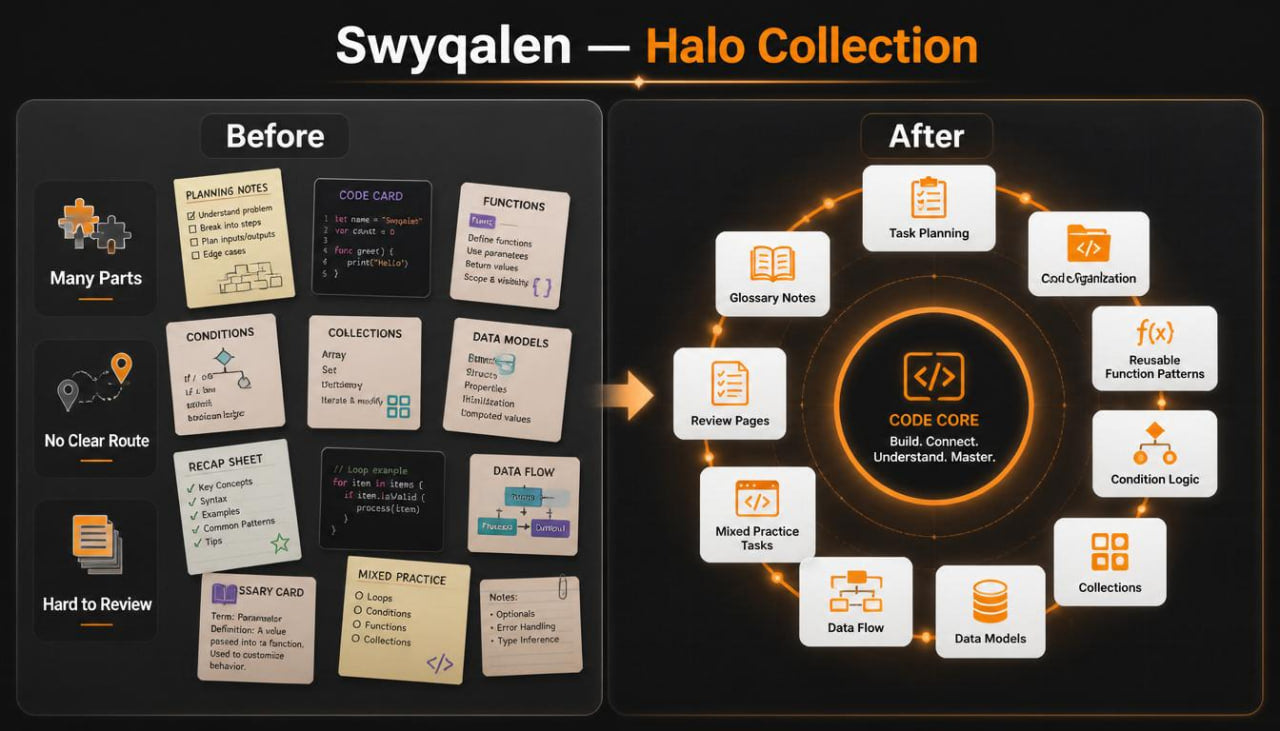
Problem Statement
At the later stage of Swift study, learners often need more than topic-by-topic explanations. They may already understand values, functions, conditions, collections, loops, and data models, but still need more practice reading how these ideas work together inside layered examples. A learner may also find that larger samples become harder to follow when the data moves through several functions, branches, and grouped values. Another common issue is that study materials sometimes show a finished answer without showing the planning behind it. Halo Collection was created for learners who want a wider, more connected Swyqalen tier that explains the path from written task idea to structured Swift example. -
Solution
Halo Collection gives learners a broad written course collection built around careful planning, readable code structure, and practical review. The course shows how a task can begin as a short written scenario, become a planning outline, and then turn into Swift code with named values, functions, conditions, collections, and data models. Each module follows a steady rhythm: explanation, annotated example, practice task, recap page, and review prompt. Learners are guided to study code by sections instead of trying to understand everything at once. This tier is made for learners who want a fuller study collection while still keeping the learning format calm, organized, and readable. -
What’s Inside
Halo Collection includes the broadest set of Swyqalen learning materials in this tier group. The course begins with an orientation section that explains how the collection is arranged, how to move through each module, and how to use recap pages during review. This opening part also introduces a study method based on five actions: read the task goal, mark the data, follow the function flow, review the condition path, and compare the result with the original scenario.
The first module focuses on task planning. Learners study how to take a written idea and turn it into a small coding outline. This includes identifying the goal, choosing the needed values, naming each part, deciding which functions may be useful, and marking where condition logic should appear. The examples show planning notes beside Swift samples, so learners can see how the structure is formed before the full code is reviewed.
The second module covers code organization. Learners review how to arrange values, functions, conditions, and collections in a readable order. The module explains how grouped sections can make a code sample easier to follow, how naming can describe purpose, and how unnecessary repetition can be reduced through smaller reusable parts. Practice tasks ask learners to reorder short examples, rename unclear sections, and describe the role of each part.
The third module focuses on reusable function patterns. Learners study parameters, return values, helper functions, and grouped function flows. The examples show how one function can prepare information, another can check it, and another can return a final result. Learners complete missing sections, mark the input and output of each function, and review how several functions can work together without becoming crowded.
The fourth module explores condition logic in layered examples. It covers multiple checks, fallback branches, grouped decisions, comparison patterns, and cleaner ordering of logic. Learners review examples where different input values guide different results. Practice pages ask learners to label each branch, explain the reason for each check, and rewrite crowded condition blocks into a cleaner structure.
The fifth module focuses on collections and repeated work. Learners study grouped values, repeated actions, simple selection patterns, small updates, and result-building tasks. The examples show how a collection can hold related data, how each item can be reviewed, and how a final value or list can be formed from selected items. This module includes reading tasks, missing-line tasks, and short rewrite exercises.
The sixth module covers data models and organized information. Learners review how related values can be grouped into small structures and used across functions and collections. The module explains fields, sample records, grouped data, and simple relationships between pieces of information. Learners practice reading data models as organized information rather than separate lines of code.
The seventh module focuses on data flow. Learners trace values as they move from creation to use inside functions, conditions, collections, and data models. The examples include side notes that explain where information begins, where it changes, and how it contributes to the final result. This section is useful for learners who want to understand not only what a line says, but how it affects the wider sample.
The eighth module brings planning, reusable functions, conditions, collections, and data models into mixed practice tasks. Each task begins with a short scenario, followed by a planning note and a partially completed Swift sample. Learners complete missing parts, label the structure, review the logic, and compare their work with selected answer notes.
The ninth module is a review section with recap pages, glossary notes, marked examples, and self-check prompts. It gathers the main patterns from the course into a reference-style format learners can return to after finishing the main modules. The recap pages focus on naming, data flow, function structure, condition order, collection handling, and mixed practice review.
Halo Collection also includes final study prompts, selected answer files, and extended review tasks. The materials are arranged for repeated reading, careful practice, and steady review across a wider set of Swift study topics.
-
Who Is This For?
Halo Collection is for learners who have already worked through earlier Swift topics and want the widest Swyqalen tier in this course path. It is suitable for learners who understand the basics and want more practice with connected examples, planning, data movement, function structure, condition logic, collections, and data models.
This tier is also for learners who prefer written learning materials with detailed explanations and practical exercises. It fits people who like to read carefully, mark code sections, complete guided tasks, and return to recap notes after each module.
Halo Collection may be a good fit for learners who want a larger study collection without loud marketing claims or overloaded formatting. It does not try to cover every possible Swift topic. Instead, it focuses on structured study, organized code thinking, and practical review through written modules and guided tasks.
- What You Will Learn
- How to turn a written Swift task into a structured outline
- How to identify the goal of a code sample before reading details
- How to choose names that describe the role of values and functions
- How to arrange Swift code in a readable order
- How to reduce repeated patterns with reusable functions
- How parameters carry information into functions
- How return values move information out of functions
- How grouped functions can work together in one flow
- How condition branches guide different results
- How fallback paths can be written with care
- How collections hold grouped values
- How repeated actions review items in a collection
- How simple selection patterns can form a result
- How data models describe related information
- How values move between data models, functions, and collections
- How to trace data through a layered Swift example
- How to complete mixed practice tasks with several connected topics
- How to use recap pages and glossary notes for later review
-
30-Day Refund Window
Halo Collection includes a 30-day refund window for learners who find that the course materials do not match the written description or the order details. Learners can contact Swyqalen support within 30 days of purchase and include their order information with a short explanation of the issue.
Self-paced learning overview
- 📁 Digital file available after purchase
- 🧭 Long-term availability
- 🔐 Secure checkout
- 🗓️ Content updated in 2026
What format are Swyqalen courses provided in?
What format are Swyqalen courses provided in?
Swyqalen courses are provided as digital learning materials with written modules, examples, practice tasks, recap notes, and organized study files. The materials are made for reading, reviewing, and working through topics at your own pace.
Do I need prior Swift knowledge before choosing a tier?
Do I need prior Swift knowledge before choosing a tier?
Some tiers are made for early study, while wider tiers include more topics and deeper practice. Each course description explains who the tier is intended for, so learners can choose the option that matches their current study stage.
Can I study the materials gradually?
Can I study the materials gradually?
Yes. Swyqalen courses are arranged into sections, so learners can study one topic at a time, return to earlier pages, and repeat practice tasks when needed.
Share